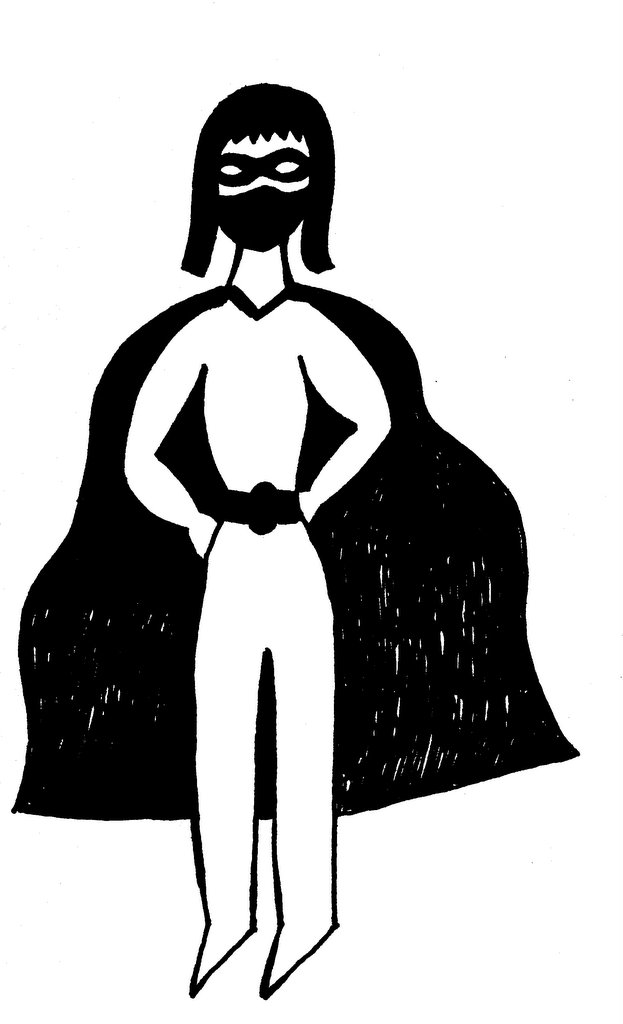
Want to understand how Multiple Chemical Sensitivity (MCS) impacts and changes people? Want validation for your own experience as a chemically-sensitive person? Want to expand your thinking about the social context of this political hot potato of a disease? Want to leave the unconvinced hand-wringers in the conceptual dust, wasting their breath on the controversy over the problem's existence, while you speed off to new intellectual horizons with the wind in your hair? If so, author and psychologist Pamela Reed Gibson is your gal. Her words are like alpine air to an asphyxiating person and I try to read every last one she puts down on paper.
Last year Gibson and some colleagues published a study* (available through CIIN) on how MCS changes people's sense of who they are. (For those who'd prefer a less academic introduction to her work, the first edition of her wonderful book, Multiple Chemical Sensitivity: A Survival Guide, is reviewed on Amazon and the second edition can be purchased at www.earthrivebooks.com.) Gibson's team hypothesizes that the always-difficult adjustment to chronic illness might be particularly problematic for those with diseases like MCS that aren't understood or generally recognized as real. For the study, they analyzed a couple hundred replies to a questionnaire asking the mostly-female and mostly-white respondents about changes in their identity resulting from the illness.
It does seem, when illness becomes chronic, that one is eventually pulled to divert some attention from the quest to get back to one's "old self" and to try to accept, discover, or create a "new self." Gibson et al. review previous work characterizing that process in the case of accepted diagnoses. The cited researchers collectively paint a picture of a diminished or fragmented sense of self that ideally shifts to a more positive, integrated one that incorporates the effects of the disease. I could recognize myself in the description of an attempted short-cut to the desired transformation: A "well" identity is maintained for interacting with others while an "ill self...copes privately with the demands of the illness." (That's a trick, by the way, that's easier to pull when you can keep the illness invisible.) An important psychological task in making the positive shift is separating one's sense of self from the disease, not blaming oneself. The study authors point out that medical validation for this distancing is often lacking with MCS. Indeed, I'd say, doctors often actively discourage the effort.
Before I touch on the research findings let me say a word about Gibson and friends' refreshing approach to their project. First of all, they come out of a school of thought that doesn't conceive of knowledge as objective, but as socially constructed. Their goal isn't so much to get at any absolute truth as to instigate social change through the illumination of oppressive constructs. They describe MCS as "psychologized" and "delegitimized" condition and the "marginalized" people who have it as "situated in an experience constructed as 'not real' by dominant social and economic forces." They seek a "dialogue with the subjects of their investigation, whom they respectfully refer to as participants, and they want to provide "a forum for the expression of voices unheard in mainstream medical discourse" (the patients', that is). As it happens, I find myself situated in an experience where tortured social science jargon can sound like lute music on a breeze to my marginalized ears.
The eight common themes culled from the questionnaires reveal, for starters, a sad litany of losses in both the material and non-material realms for people with MCS. I found reading about those many losses momentarily overwhelming at times, but, on balance, having them carefully catalogued and clearly articulated was enormously helpful. I felt able to pin down more precisely the nature of the struggles I face and less alone with it all.
Under a thematic category called "loss of a stable, familiar personality," Gibson's group reports participants variously feeling that they had become more fearful, less independent, more self-centered, less tolerant, more mean-spirited, more envious, less kind, less fun-loving, less valuable, and less self-valuing. (Nobody slit your throat yet, experiences of growth are covered in other categories.) One woman is quoted at length describing the difficulty of knowing who she had become when her emotions and behavior had been frequently affected by chemical exposures over a significant period of time. "I am no longer a separate entity," she writes, "I am what I am with the influence of the chemicals now."
Another theme covered losses related to "self-positioning," or relationship with the world. The researchers suggest that losses related to employment were the most impactful on identity, although people also had profound changes in their roles as partners, parents, and friends. Respondents described their wasted potential and inability to contribute what they would have to their families and communities. I couldn't help wonder if identity concerns might not be a secondary consideration for someone who had become indefinitely homeless through a loss of livelihood. In this section and elsewhere I would have appreciated some separate discussion of those in the most dire circumstances (if, in fact, they were represented).
Another theme involving the social self was identified as "emotional suppression to meet others' expectations." Participants related hiding their illness and their feelings about it, even from loved ones, to prevent isolation, loss of relationships, and negative judgments, both spoken and unspoken. One comment I found ironic came from a participant who deprived herself of desired psychotherapeutic help because she considered it crucial not to risk being labeled as "a 'crazy' EI." (I think the same institutions that push us toward psychological help often simultaneously prevent us from receiving it.) The analysand wannabe describes her necessity, somewhat mysteriously, as a "political" one. However--again considering the worst case--I thought of people for whom a job or other means of survival might be threatened by honesty about their illness-related experience or needs.
Some portion of those surveyed felt they had developed various positive qualities, or become better people overall, through meeting the challenges of MCS. I found their testimony inspiring, at least when I could avoid comparing myself to them (or to their self-images). They described themselves as wiser, emotionally stronger, more self-aware, more in touch with nature, less in need of external validation, more informed, spiritually richer, more confident, more life-loving, less materialistic, more politically aware or involved, and as having a stronger sense of self, more balance in life, and clearer priorities. In my reading of these positive accounts I didn't see much emphasis on greater abilities for connecting emotionally with others, which made sense, but seemed a sad comment.
The Gibson study is noteworthy not just for detailing the impacts of a nasty disease but for characterizing the institutionalized mistreatment of the victims in society and the reasons for it. One identity it validates, and even encourages, without explicitly discussing it, is that of "member of a socially-oppressed group." The authors do discuss the "activist" identity taken on by some people with MCS, noting that it doesn't measure up to cultural expectations for hard work and success. But not all MCS patients have sufficiently good health to be active in any sense of the word, and activism that doesn't recognize what it's up against, externally and internally, can be misguided and frustrating. It seems to me that we MCSers need to exonerate ourselves from responsibility for our social oppression as much as for being sick. I think doing so can actually result in a more measured, reasoned advocacy for ourselves, both individually and collectively. For help with the job there's nobody like Pamela Reed Gibson.
*Gibson, PR, Placek, E, Lane, J, Brohimer, SO, and Lovelace, ACE. (2005) Disability-Induced Identity Changes in Persons with Multiple Chemical Sensitivity. Qualitative Health Research 15(4), 502-524.
Friday, May 26, 2006
Who Do We Think We Are?

Sunday, May 07, 2006
Check Out Nontoxic Radio
Last week I got a mysterious e-mail from "The Voice of Reason." This apparently-human embodiment of logic and sense had deduced that I might be interested in a weekly radio show airing on a low-power FM station in Massachusetts. Sure enough, "Antidote Radio", hosted by the Voice herself, covers a variety of topics related to Multiple Chemical Sensitivities (MCS). Better yet--for those of us trapped outside a 10-mile radius of WXOJ-LP--the show streams over the internet. On my rare and vintage computer set-up it doesn't so much stream, as drip, but, with patience, work-arounds are possible. (Come on, you sighing MCSer out there, you can do it, your life is a work-around.)
Boy, I understand why those media monopolists are trying to get the internet under control. (Stop them.) I felt a little giddy considering the possibilities of a weekly international webcast representing the perspective of people with MCS. Even if bed-ridden, we could get the latest, hear each others' voices, organize to advocate for ourselves. No cosmetics executive would be able to pull our programming. Maybe, if we were funny, and the tiniest bit subtle, we'd be invited to roast our enemies at their own table, a la Stephen Colbert. (Through a heads-will-roll failure of domestic intelligence the comedian was allowed to satirize our Prez at length, to his face, at a televised dinner.)
Anyway, starting small, support your Voice, listen to "Antidote Radio." You might even hear a conversation with a currently text-bound chatterbox posing as a superhero.
Thursday, April 27, 2006
Exposed
I have little idea how healthy people will respond to Exposed, a new documentary about a woman with Multiple Chemical Sensitivities. I responded with, "hey, look, it's my life on the screen," but I also kept thinking about them (you?)--the chemically tolerant folks. Squirming a little, I wondered if the general public would be sympathetic as the woman, named as Katherine, delivered herself up to the camera in painful, private moments--exposed indeed.
Katherine, while attractive and personable, is no air-brushed poster child for Multiple Chemical Sensitivity (MCS). An avant-garde dancer and performer who often filmed herself, she's not suffering quietly or demurely. After a bad chemical exposure she weeps into the phone with distress and frustration, trying to wring some emotional support out of an apparently unattuned listener. "No, I don't have the flu," she says between clenched teeth, "I have environmental illness." In another particularly raw scene she speaks angrily to the camera while washing her hair outside on a cold winter day. She is away from home and going to such lengths in order to avoid breathing in the synthetic chemical fragrances in a friend's bathroom.
In addition to allowing us a window into her daily life, Katherine offers a social commentary--particularly addressing the widespread denial of MCS as a real disease. The filmmaker, Heidrun Holzfeind, does not establish much of a separate directorial perspective distinguishable from this critique. Between shots of Katherine, Holzfeind does intersperse, for effect, segments of 1950's-era marketing footage from the chemical industry, as well as shorter snippets of modern advertising and political speech. Also presented is some disturbing science supporting the reality of chemical dangers. It's clear the director is on Katherine's side, but Holzfeind allows her to be the one to draw the more subjective conclusions.
I didn't find much with which to quibble in Katherine's analysis, although it took the form of off-the-cuff, often biting, remarks rather than closely-reasoned or factually-documented arguments. Again I didn't know how it would play with the uninitiated. She rhetorically kicks mainstream doctors to the curb. She identifies industry's cynical, profit-driven opposition to recognition of chemical harms. And she indicts "chemical culture" for such faults as an emphasis on the quick fix and a need to control--in contrast with her own hard-won belief in the need to be patient and allow her body to heal itself.
In one of her moments of reflection, Katherine talks about needing to set aside what she knows in order to interact socially in a normal fashion. Unsure of her meaning, I guessed that she was talking either about pretending to be healthy and happy, or about tacitly accepting generally-shared assumptions that no longer fit her experience--for example, that we live in a benign environment. She certainly doesn't seem to be suppressing much in Exposed; she's practically screaming out her truth. While I worried about the P.R. impact on the one hand, on the other I felt vicariously thrilled by her lack of apology and aggressive assertion of her reality in the face of its denial in so many quarters.
I, for one, would rather see someone being genuine, engaged, and angry than someone silencing herself, in order to fit in, at the expense of her health. Yes, I'm sure there are more enlightened options and I'm also sure that Katherine--and a certain slightly abrasive blogger--are working toward manifesting them. In the meantime, I hope as many members of the well populace as possible will see this film. And I hope they respond with compassion to the story of a real, struggling person rather than waiting for diplomatic coaxing before taking to heart her crucial messages
Wednesday, April 05, 2006
The Tomato Effect
Some dirty politics have been brought into play by the emergence of a chemically-induced illness known as Multiple Chemical Sensitivity. Anyone interested in understanding them should find a way to see the new documentary The Tomato Effect. In it, the camera follows Faun Kime (who also wrote, produced and directed the film) as she tracks down the truth about her father's death a decade earlier. She sets out to learn if there is any basis for the suspicions raised by his fatal mountaineering accident in 1992.
In the film, Kime's narration of her moving personal journey is skillfully interwoven with the still-unfolding history of a witch hunt. The California Medical Board systematically persecutes ten loosely-associated physicians who treat patients with Multiple Chemical Sensitivities (MCS). Kime's father Zane, one of the doctors, died just before the climax of his precedent-setting legal battle to retain his license. His case was expected to exonerate the maligned practitioners of a developing medical specialty termed environmental medicine.
The film's political focus is largely confined to California. We witness the effects of powerful, unscrupulous forces operating within the state to protect their financial interests. Various parties stand to lose if legitimacy is granted either to environmental medicine or to the MCS diagnosis and its recognition as a man-made problem. In relatively brief segments Kime does suggest a national backdrop: The EPA practices willful denial; the allergists' society is trying to protect patient "market share;" and the chemical industry plays the role of chief villain with deep pockets. The tales the film tells, however, all take place in and around the San Francisco Bay Area. We see interview footage with a handful of people who constitute a microcosm of the larger conflicts.
One representative story involves a policeman who is chemically injured on the job by a spill at a Chevron oil refinery and develops MCS. He describes starting to recover after being put on disability by an environmental medicine specialist only to be ordered back to work by a company-chosen allergist, Abba Terr. He goes back and forth between the two doctors, his health yo-yoing up and down depending on who is calling the shots. At some point he initiates a law suit. While Terr is charging fees of $600 per hour as an anti-MCS "expert," the other doctor, Joseph McGovern, faces humiliation. With the Chevron case still pending, the medical board accuses McGovern, in a singularly outrageous charge, of insanity. (Of course MCS patients suffer this indignity routinely, but usually less publicly.)
Kime conducts a particularly telling interview with one doctor who averted the destruction of his career. He cheerfully admits to buying his way out of his predicament with hefty campaign contributions to first a Democratic and then a Republican governor. "Republicans are generally cheaper than Democrats," he quips. He is himself appointed to the medical board and investigation into his conduct is dropped. He comes across as more savvy, and paints himself as more cynical, than the filmmaker's idealistic father. Zane, the elder Kime, declined to use his colleague's connections to save himself in favor of legal and legislative battles that might have spared others.
The Tomato Effect takes its title from a term describing the rejection of effective medical treatments because they conflict with currently-accepted theories. Additional definitions explain the historical origins of the term and describe the more general fallacy behind the phenomenon. At the end of the film, Kime ties her narrative threads together within the context of the broader meaning. She leaves the viewer confused, however, as she arrives at a jarring last-second conclusion that fits tidily into her conceptual scheme, but contradicts earlier revelations. This final brush stroke is unfortunate and unnecessary. The film already has a sufficient sense of resolution and its emotional power lies simply in the side-by-side presentation of one person's sincere effort to lay bare the truth and the machinations of the utterly corrupt in trying to conceal it. Thanks are due to Faun Kime for her willingness to take on those dark forces bearing only the insubstantial weapons of honesty and a movie camera.
Thursday, March 30, 2006
Supergirls
Today's post features some special invited guest authors and might be titled "Everything I ever needed to know I learned in kindergarten and was able to fully articulate by the second grade." Jessica and Rachel are self-chosen pen names for a pair of twins it has been my great good fortune to know since their birth, which was not so very long ago. They and their exceedingly generous parents took me in for several weeks last spring when I was at my wit's end with my Multiple Chemical Sensitivities and my own home seemed to be making me sick. I hope you find their sweetness and fresh perspectives as healing for whatever ails you as I have.
Who is the the Masked Avenger?
Rachel: The Masked Avenger is my friend. She has an illness that she's very sensitive to smells.
Jessica: The Masked Avenger is my friend actually. She is allergic to many things, like spices and more stuff.
Why did she come stay at your house?
Jessica: She came to stay at our house because her friend gave her a computer. She opened it and it smelled. She was allergic to the smell.
Rachel: She came to our house because she was visiting us.
Where in your house did she stay?
Rachel: She slept on the cement floor because the rug in the guest bed had a smell she was allergic to.
Jessica: She was also in the backyard a lot because she needed fresh air so that she wouldn't have to stay in the house too long because the house had new paint and she is allergic to new paint.
How was she feeling?
Jessica: She was feeling bad; that's why she came to our house. But we made her sort of feel better while she was at our house.
Rachel: She was feeling bad.
Did she wear anything strange? (I had on a charcoal face mask much of the time, but loving eyes...)
Rachel: No, she just wore jeans and a sweatshirt.
Jessica: No, she just wore regular clothes.
What do you understand about her sensitivities?
Jessica: She's sensitive about new things because new things smell because they are new.
Rachel: She's very sensitive to a lot of smells.
How did you have to change things when she came?
Rachel: We had to take all of our soaps out of our bathrooms.
Jessica: First let me tell you a story. One day we went to a store and there was an aisle and we were looking for soap and the Masked Avenger was with us. She said I can't go in that aisle; I'm allergic.
Were you ever sensitive to anything?
Jessica: I'm sensitive to Good Earth Tea. What happens when I drink Good Earth Tea is I have a rash all the way around my mouth.
Rachel: My sister is my twin and I'm allergic to that tea too.
How did your family help the Masked Avenger?
Rachel: We were at a friend's house and we brought the Masked Avenger some uncooked sweet peas and she said she felt better. (M.A.: It's true, certain tender sweet peas act almost as a magic potion.)
Jessica: We let her stay outside for a lot of the day and gave her good dinners and we just helped her.
What else do you remember about her visit?
Rachel: I was really happy to see her when she came.
What would you tell someone else who had a sick friend?
Rachel: I bet you're a really good friend and I bet that person really likes that you're helping her.
Jessica: Would you like me to help? If they said yes, I would just help the person.
Thursday, March 23, 2006
Movie Teaser
Check out the trailer for a new documentary film called The Tomato Effect. It's showing at very, very select locales. I joked on this blog a few months back about seeing what activism could bring by watching the movie Silkwood, which is about a whistle-blower at a nuclear power plant who died mysteriously. (I thought it was well done, if disturbing. The image of Meryl Streep's terrified face in the scenes in which her character sets off the contamination alarms at the plant will stay with me for life.) Little did I know that those of us with Multiple Chemical Sensitivities (MCS) have our own mysteriously fallen champion. I can't vouch for the documentary now, but when it comes someplace within driving distance of me I'll let you know what I think.
Also, if you haven't seen Safe, with Julianne Moore playing a woman with MCS, I highly recommend it. I first saw it, with ill-considered bravado, on day four of my illness, when it happened to be showing in theaters after its original release. I experienced it then as a horror movie, but upon reflection think it's as good a disease movie as we, the afflicted, could possibly hope for.
P.S. Check out the links in the comments to this post for something way more interesting than what's above. Still, I would defend Safe from critics who think it doesn't make a social critique. I think it's widely misinterpreted and that it makes nothing but blistering social critique in every frame.
Tuesday, March 21, 2006
How the Avenger Got her Bionic Nose
In the ancient personal history of many superheroes is the story of how they acquired their remarkable powers. While I am something of a self-styled crusader against evil, in this regard I am no exception. I couldn't always smell perfume from a distance the length of a tall building or escape it as fast as a speeding bullet and I will tell you how I came by these talents.
I was thirty-six when I came down with Multiple Chemical Sensitivities (MCS) eleven years ago. I'd been in ill health already with bronchitis and unusual fatigue. I started noticing that I was bothered by things like scents in the cleaning supplies aisle at the grocery store. Imagine swimming in a vat of Pine Sol. It didn't smell "clean" or "fresh" anymore. It smelled poisonous.
When I told my doctor she looked at me sharply and said, "you know such things can be serious." I felt warned and somehow reprimanded, yet her only suggestion was that I drink a lot of water. A few weeks later results were back from tests she'd ordered and she announced that I had an Epstein-Barr viral infection, which I later learned, God help me, was a controversial diagnosis--for me, controversial diagnosis number one. She didn't suggest any treatment, other than rest, and, again, the water.
I went to the beach for a week and headed home feeling generally better. In my absence my roommate had decided to spray Raid Flea Killer on the rugs in our apartment, intending well by doing it while I was away. Given my reaction when I set foot through the door it might as well have been nerve gas. I spent the next days and weeks feeling as if I had some strange variant of Alzheimer's disease. I was having intense reactions to all kinds of things: my shampoo, cigarette smoke, perfume, dishwashing liquid, hand soap. They seemed to go straight to my brain, as if I was smoking something on which 13-year-olds try to get high.
Even when I wasn't feeling acutely poisoned by formerly innocuous odors I felt foggy and disoriented. I was losing my bearings, losing my keys, losing the words I wanted. In a related move, my roommate was losing her patience; she wanted the stove off and the door locked when I left the apartment. The short-term reactions--during which I really couldn't think straight--began lasting longer and longer. I became afraid I was incurring permanent brain damage.
After the flea killer episode I wasn't able to tolerate the air at my day job for a minute. One of my co-workers elicited general amusement with, "Yeah sure, we're all allergic to this place." In fact a number of people had made earlier complaints about the air quality in the high-rise. The windows weren't the opening kind and there had been constant remodeling as the company had grown. We had new computers, new carpeting, and new paint. We had new fabric-covered cubicles squeezed into the minimal amount of space that would hold them. Management had dismissed the concerns with a number. I seem to remember the figure 16, but not the units, something relating to fresh air intake, something that felt irrelevant to me as I was descending into dementia. I quit and applied for disability.
At home I had piled the insecticide-sprayed rugs and other items that failed a sniff test in the living room, provoking glares from my alarmed roommate who was now clearly finding my behavior bizarre in addition to insupportable. Once my bedroom had been stripped of immediately-offending contents I blindly thought of it as a safe place. I wore a carbon-coated dust mask on the street--despite the stares--to protect myself from car exhaust and thought I'd done all I could. Then in dawned on me that the black mold that grew readily on the walls of our dank apartment was a health hazard. I committed myself to a new rental sight unseen and, before moving, discarded my mattress and upholstered living room furniture. With grief I parted with my books, all of which smelled of mold.
The first real check on my free fall came when I took another trip out of town. I stayed inland this time, at a rustic cabin that served as a way station in my move. Upon arrival the first day I felt a visceral, almost mystical, connection to the trees--big oaks and redwoods--which I had never felt before and haven't since. Lest anyone get misty-eyed, let me say I'm now allergic to any number of trees. That day, though, when I stepped out of the car, I was breathing, drinking, absorbing the trees. I felt distinctly better every subsequent day of the week I was away. There was less around to provoke reactions, my baseline state improved, and the reactions I did have were less devastating. I wasn't out of the nightmare, I still was avoiding much of the world, but I had tasted relief.
On my way back to the city I visited a specialist referred by my doctor, an "environmental medicine" specialist--controversial doctor number one for me. He officially gave me controversial diagnosis number two, Multiple Chemical Sensitivity (MCS), then commonly known as Environmental Illness (EI), not that this was news to me at this point in the game. At my impatiently-awaited first visit he talked to me in a friendly way, at a leisurely pace, about measures for curtailing mold growth in the home. Among other things he suggested that potted plants and wicker baskets might no longer be good decorating ideas for me.
I couldn't understand his nonchalance. I tried futilely to impress upon him that I was in crisis and in need of immediate intervention. Perhaps he thought it was reassuring to act unconcerned, but to someone trying to put out a fire he seemed hopelessly out of touch with my reality. He sold me a sackful of expensive nutritional supplements, tablets of blue-green algae and the like, and said he thought I would get better. I stumbled out of his office, looped from something I'd inhaled while inside, and not believing that was it, all for which I'd been waiting. I thought another hour with the trees would have been a smarter bet.
When I reflect on that initial crisis what strikes me most about it was how alone I felt, and how abandoned by my society. I did get better. I got much better for long periods of time (although not to any degree approaching normal), and I am grateful for the help I got in my recovery. I did have a few friends who did what they could and came through for me in crucial ways--leaving off the hair gel, understanding and believing me, putting their needs aside for awhile. I had a chemically-sensitive acquaintance who sold me his old air filter, told me where to buy unscented shampoo, and shared other survival tips. I wouldn't have given up his counsel before that of any M.D. I saw. In the longer term I had an acupuncturist who seemed to understand something important about what was going on, even if she talked about it in terms like "chi" and "wind" that meant little to me, and I thought she was able to affect some change.
Despite all this, nine tenths of what had to be done I did myself, sick as I was, and felt no choice about it. I got better largely through making lifestyle changes far more drastic than giving up wicker. I remember countless trips to futon and bedding stores for sniff tests and custom orders. I carted a series of mattresses in and out of my new place until trial and error yielded one I could tolerate. I remember sitting on the floor and crying over an all-organic-cotton futon that had required a doctor's prescription to be custom-made without flame retardant. It stayed in my bedroom only long enough for me to shed and dry my tears. It turned out that certain cotton fibers used in batting, cotton linters, were a common allergen.
Getting better involved some luck, such as my new place chancing to be environmentally hospitable, and also a certain ruthlessness of which I'm not entirely proud. A man I was seeing at the time didn't rise to the occasion, or even seem to grasp that there was an occasion that called for rising. I witnessed his response with icy clarity and eliminated him from my life with as little ado as I could arrange.
Doctors of Medicine, with few exceptions, only proved helpful because they were in a position of power. They, and only they, could corroborate my story for government agencies. Even if they believed me they often resented this role--a role that it seemed to me they as a group had secured for themselves and jealously guarded. While they may have felt that recording my misery for third parties was beneath them, they ate up a lot of my financial resources with little other result. My health insurance did not cover most of my medical expenses (certainly not controversial treatments one through five) and I couldn't afford the big name doctors.
About a year ago I relived a version of my original collapse. Life since then has impressed upon me how little has changed in the spheres of medicine, law, and government for those with MCS, particularly if a sufferer doesn't have a lot of money. I still feel abandoned, if less stunned by finding myself so. There are still no accepted ways to diagnose or treat the disease, nor is there even acceptance that it exists. There are no hospital environmental units in this country, no accessible hospice beds. There are precisely eleven affordable housing units built for MCS access (Ecology House) and the waiting list for them is a mile long.
I know my outrage and sense of entitlement to something better reflect the relative privilege in which I grew up. There are many people abandoned by our society in worse shape who complain less of their fate. Still, I claim the right to outrage on my behalf as well as theirs. No one should have to go through what was preventable of my ordeal, and much, arguably all, of it was.
Friday, March 10, 2006
Big News on Biomarkers?
Tune in here folks for news and views on Multiple Chemical Sensitivity (MCS) that are secular, civilian, and, I'm afraid, stale. This week I learned from an organization called Share, Care and Prayer that $7.2 million spent by the Department of Defense for study of Gulf War Syndrome has netted evidence of specific biochemical differences MCS patients have from the general population. Researchers at Wright State University Medical School in Dayton, Ohio reported differences involving levels of certain enzymes which detoxify harmful substances in the body. Across the page from a poem about Jesus I read:
"We were able to clearly discriminate between normal and sensitive groups," said Gerald Alter, who did much of the enzyme research. Just by analyzing blood samples, colleague Steven Berberich said, he could tell a sensitive patient from someone else.
S.C. & P. had reprinted an article by Kevin Lamb in the Dayton Daily News from last October. I was excited, but also baffled. If the article was accurate it reported big news in my world, but I felt as if I was learning it from a line of first graders playing a game of telephone. Why was this seemingly marvelous breakthrough being reported only in a local Ohio paper? Why was it reaching me only now despite my every effort to keep my ear to the ground? Was it really such big news?
As I write I am in hot pursuit of the answers to these and other questions. The most pressing to me is the question of whether both researchers cited above are quoted correctly, because they are saying quite different things. Discriminating between groups of people isn't such a breathtaking accomplishment (although many have failed in the case of MCS). You can distinguish a group of Sumo wrestlers from a group of randomly chosen Japanese men by weighing them. However, knowing the weight of any given Japanese man won't allow you to determine if he is or is not a Sumo wrestler. It helps you determine the likelihood one way or the other, but it proves nothing. Moreover, the differences between the MCS patient group and the normal group might be far less dramatic than my example--as if, say, there were only a few pounds difference between the average wrestler and the average citizen.
It would make my day to know a blood sample could be used to prove that a particular person had MCS, even to 90% certainty, even if that person wasn't me, and even if the development of a clinically available diagnostic test was years away. Just the knowledge would be a comfort to me after I get told by some lawyer that if I want Social Security benefits and I can't come up with proof of my MCS I may have to "accept" a psychiatric diagnosis. However, if MCS people fall within a "normal range" on some measure 90% of the time my enthusiasm is dampened. Either way, of course, I'm endlessly grateful to researchers who take the condition seriously enough to study it.
When I called, the official spokespeople at Wright State University were friendly and generous with their time, but they were backing away from the more exciting claims and not tipping their cards beyond their already published press release. They said there was nothing scientific to read yet. The results hadn't been replicated, hadn't been published, or perhaps hadn't even been submitted for publication. A progress report had been submitted to the D.O.D. but might be secret from the public. They had only notified the local paper because the surrounding community had a lot of sick vets and was following the fate of the $7.2 million that had come into its midst. Both of the people I reached spoke earnestly of raising false hopes as the worst sin they could commit.
The air of mystery only whets my appetite for the hard facts. You'll see them here as soon as I get them, probably last.
Friday, January 20, 2006
The Psychiatrist
Spitting mad. Fuming mad. Rumpelstiltskin mad. Yes, I am one angry girl. I met yesterday with a psychiatrist at my HMO, hoping it might bolster my disability claim. I'm not saying this man was unattractive, but if I found myself alone on a desert island with him I would view him as food. Yes, cannibalistically mad. But we weren't alone on a desert island; we were in a situation out of an Edith Wharton novel, one in which deviations from social protocol were fraught with devastating consequences. Various interconnected bureaucracies which controlled my fate were to be moved by what he wrote down after we spoke. So I strove for absolute decorum. For deference. For compliance. Judge me if you like, but haven't you felt this way toward a boss at some time in your life?
There was irony in the means by which the psychiatrist was provoking my fury. In an obvious, ham-handed way, he was painting a picture of me as a timid person who was projecting my fears onto a benign environment, believing it to be filled with imagined chemical threats. As I was struggling to conceal my rage he was saying, with exaggerated sympathy, " you must experience the world as a very frightening place." I assume he is of the school positing that all patients who believe they have Multiple Chemical Sensitivities are operating under a delusion. I could have told him that I did have a terrible fear of letting slip snide remarks that would provoke him to retaliate against me in his chart notes, but I mumbled something vague that could be taken as an assent.
Before I go on, I should say I went into this appointment with quite specific goals for the psychiatrist's larger decisions, all of which were met. He gave me the diagnosis I wanted, saying I had a low-grade depression, which is true enough. He didn't try to prescribe medication, and, mercifully, he didn't schedule a return appointment. As an unexpected bonus, he let me know of a meditation class I might actually be interested in taking. So, I must have been doing something right, but I was aware that I was leaking hostility at various times.
"Do you have friends?" he asked out of the blue at one point.
"Yes, I have friends," I replied evenly. The tone of my voice said, "You inquire into people's social support a dozen times a day and this is the tactful phrasing you've perfected? Why not ask if I have any friends at all?"
After discussing the meditation class, he asked, "So, how do you feel about what I think?"
"I don't know what you think," I shot back brightly. Between the lines any astute observer would have heard, "Don't imagine I can't guess well enough what you think, you transparent fool."
He handed me a brochure listing the "behavioral medicine" classes offered by the HMO and asked if I'd seen it before. I said, "I can't tell. It looks so generic." I meant, but quickly wished to God I hadn't managed to communicate, "You are indistinguishable from every corporate clone I've ever met."
Yeah, I screwed up, but I wasn't the only one who lapsed a little from the social norm. As I was leaving I commented on a potted plant with leaves that looked like parsley, but that turned out to be something of which I'd never heard. I asked if it was also an edible plant. "We don't eat the aralia, because then it won't grow, " he said, as if issuing a warning instruction, but, strangely, in baby talk. Did he fear his shrinking violet of a patient was going to savagely destroy a living being right there in his office? Only in fantasy, sir (and not the pretty herb). Per the doctor's orders, we don't need to react just because we are aware of a noxious stimulus.